The importance of early detection: Brooke & Kaiden’s journey with CHI

I detected his low blood sugar.
By the time my son Kaiden was born, I was already raising two young daughters, and life was a whirlwind. About a month in, as we were finding our rhythm as a family of four, I started noticing little things that didn’t feel right: his lips turning blue, his legs trembling, and an unusual fussiness that wouldn’t settle. Living with diabetes myself, something inside me sensed this was serious. I trusted my instincts and checked his blood sugar with my own glucose monitor. The number on the screen stopped me in my tracks — 32. Critically low for a baby whose normal range is above 70, according to our doctors.
The number on the screen stopped me in my tracks — 32. Critically low for a baby whose normal range is above 70, according to our doctors.
That single reading changed everything. Within hours, we were in the hospital, starting a journey that would lead to a diagnosis of congenital hyperinsulinism (CHI), a rare condition that causes the body to produce too much insulin, and as a result, leads to dangerously low blood sugar levels.
Early signs that could have been missed
Kaiden had already spent a week in neonatal intensive care after being born at 36 weeks. Doctors monitored his breathing and blood sugar, partly because of my diabetes. When his levels stabilized, we were sent home.
Looking back, it’s frightening to think how easily his condition was initially missed. Doctors later told us he had likely been experiencing hypoglycemia since birth. Without early detection, the risks include seizures, brain injury, and even death. If I hadn’t recognized the symptoms, the outcome could have been devastating.
Months in hospital
Almost immediately, our lives became a cycle of hospital admissions. Kaiden was repeatedly admitted for testing, treatment trials, and constant monitoring.
Doctors started him on the only oral therapy currently available for CHI. While it helped stabilize his blood sugar, the side effects were severe. His body began retaining fluid — everything swelled. Despite high doses of diuretics, the fluid overload continued. He became fussy, uncomfortable, and unable to sleep.
Watching Kaiden suffer was unbearable… I knew something had to change.
Eventually, I reached a breaking point. Watching Kaiden suffer was unbearable, and I didn’t want to keep my two daughters away from their mom and baby brother any longer. Something had to change. I made the decision to stop the oral treatment and deliver dextrose continuously through a gastrostomy feeding tube (G-tube). For the first time, we were able to go home and regain a sense of normality.
A genetic discovery
Further testing revealed the cause of Kaiden’s CHI: a mutation in the HNF4A gene. It was a breakthrough, providing long-overdue answers. The tests also showed that I carry the same mutation, explaining my own unusual form of diabetes, known as MODY (Maturity-Onset Diabetes of the Young), which is neither type 1 nor type 2.
Even with this clarity, treatment options remain extremely limited for Kaiden. Today, his blood sugar is managed with continuous dextrose delivered via his G-tube, along with constant continuous glucose monitoring. It’s not the future I had imagined for him — but it provides stability, safety, and the priceless ability to spend time at home together as a family.
Living life on high alert
Every day revolves around keeping Kaiden’s blood sugar stable. He feeds every three to four hours, day and night. I constantly watch his glucose monitor — something we were only able to access with support from CHI International after our health insurance refused to cover it because he does not have type 1 diabetes. If his levels start to drop, everything else stops — car journeys, errands, even sleep. We travel with medical equipment, feeding pumps, syringes, backup monitors, chargers, and emergency supplies. There’s no room for error.
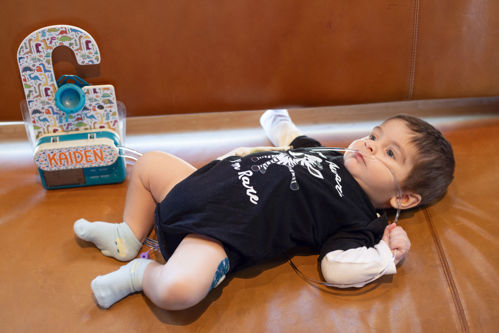
Still, our home is busy, loud, and full of love. We are happy to say that today, Kaiden’s day to day is substantially different. He is calm, happy, and full of curiosity. His sisters adore him and are fiercely protective, proudly explaining his feeding tube and monitor to anyone who asks.
The challenge families impacted by CHI face
CHI remains widely misunderstood. Many clinicians will rarely encounter it, public awareness is low, and newborn screening does not routinely test for it.
Families should not have to rely on chance or instinct to recognize a life-threatening condition. Early recognition, awareness, and support are vital.
While Kaiden’s feeding tube keeps him safe, it is not a long-term solution. Families need resources, knowledge, and care strategies that help children thrive, not just survive —and access to support, including organizations like CHI International, that can help families navigate the realities of living with CHI. No parent should have to become a medical expert overnight just to keep their child alive. And no child should have to fight for stability in their very first months of life.
The patient story shared solely reflects the unique, personal experience of that individual patient. Nothing in this story constitutes medical advice, nor should it be interpreted as treatment recommendation. Individual patient experiences and outcomes may vary and are not representative of typical results. Zealand Pharma makes no representations regarding the success or failure of any treatment, therapy, or medical intervention. Please consult your healthcare professional regarding your medical decisions.
More patient stories